Objective
Repair the user’s connection with the real world by prototyping an app that collects, curates and displays locally-focused content.
Problem
We live in a world that’s been broken by technology.
In-person social bonds are replaced with artificial social media followings. Increasingly less of our feeds are sourced from friends we know. There are more bots and fake content.
Political discourse is ruled by extreme viewpoints from antagonistic echo chambers. National and global concerns take up more of our brain space. Local news outlets are dying off. It becomes harder to connect with issues in our own backyard than problems halfway across the world.
We start the day scrolling through information about the distant world we can’t influence. We continue scrolling to increase the mind-numbing distance between us and ourselves. We end the day frustrated about the opinions of people we’ll never talk with face to face.
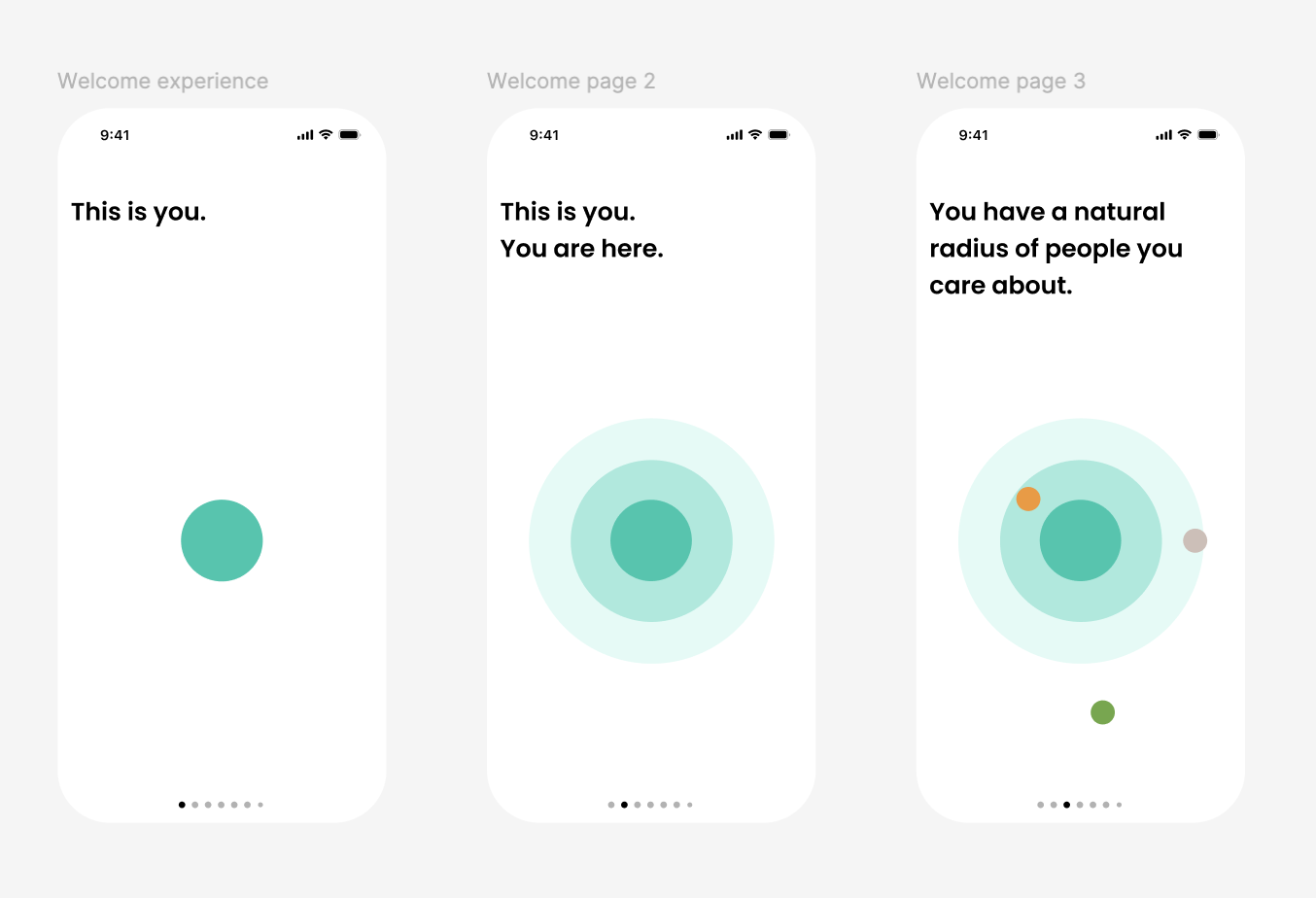
Watch the Welcome Flow video (30 sec) >
Alternative link if the first isn’t working
Solution
What if we tamed our technology? What if we reined it in to be centered you and where you live? What if we flipped the ratios so you could be more focused on your immediate environment?
The best solution to this problem also happens to feel the most impossible: put down your phone.
The second-best solution is to positively motivate a shift in focus. Instead of scolding you for screen time, what if we could motivate you to enjoy being present?
My Personal Experience
I’ve recently learned to care more about my local city.
It started 3 years ago when I bought a house in a small city. I became curious about why the city was the way it was. I tuned in to city council meetings. I read books about the city’s history. Next thing I know, I’m looking through property records to learn what my block looked like 70 years ago …and that’s just a typical Monday evening.
In this curiosity-fueled rabbit hole, I dug deeper into local content.
- Local news and neighborhood newsletters
- Local news podcasts
- Local music
- Local YouTube videos
- Local books
- Local radio stations
I was able to find a local version of just about anything, but some of it took extra work. Spotify’s song suggestion algorithm didn’t understand my local-musicians-only playlist because it transcended genres. It seemed simple to me. There was a clear, unifying thread across all songs, but Spotify’s programming couldn’t puzzle it out. I needed to manually consult local blogs, find local artists by name and read their bio to verify.
But I felt better about the content I consumed. I understood the streets I walked on. True crime documentaries hit closer to home… literally. Local content inspired me to participate in my city and created a positive feedback loop. I started to care more, learn more, care more and do more.
Empathy Mapping
My initial inspiration was motivated by an outcome not by a genuine user need. I was focused on how to get people to be more local. That was something that I wanted them to do, but good app design focuses on the user and what they want to do.
To transform this objective from self-focused to user focus, I explored some potential user needs this app could solve.
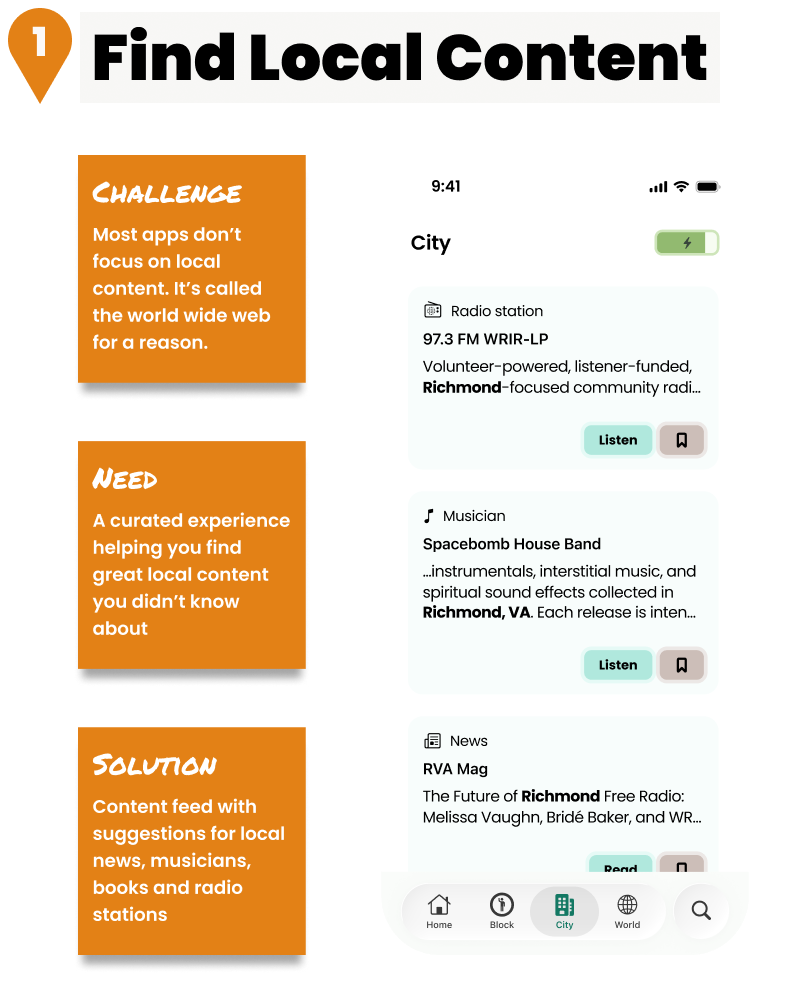
Goal One: Find Local Content
The user is motivated by having better visibility into content relevant to their location.
Challenges:
- The internet is so preoccupied with giving you everything you could ask for, it doesn’t narrow search results to within a local radius
- Some search engines assume asking for local results implies an intention to patronize a nearby business
- Most social media and music apps don’t provide local-only filters
Needs:
- Narrowed focus that still gives the user what they’re looking for
- A relevance ranking algorithm weighted for location
Potential solutions:
- Search engine limited to local results only
- Content feed with suggestions for local news, musicians, books and radio stations
- Social media feed, but only for a limited locality
- AI chat bot who contextualizes its answers to be locally relevant
Goal Two: Focus on the Here
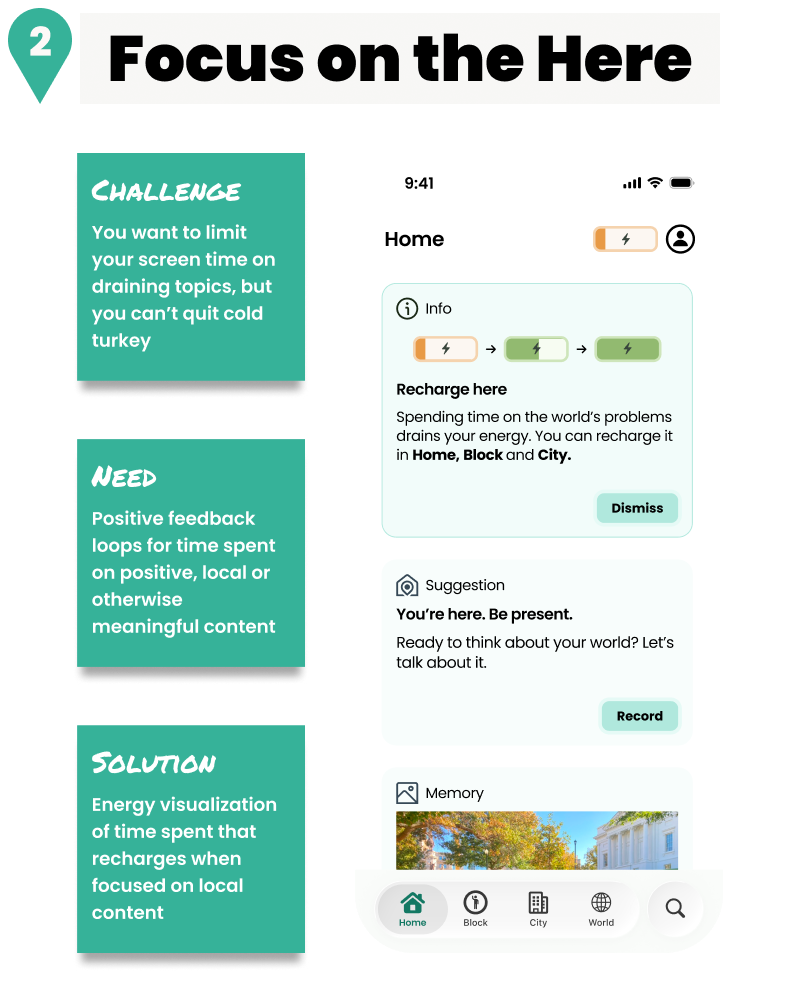
To protect their mental health, the user would like to limit their doomscrolling on national or global problems.
Challenges:
- The user wants to limit their screen time overall, but can’t quit cold turkey
- Current social media algorithms are addictive because they’re too good at serving any and all interesting content
- Doomscrolling and falling for rage bait create vicious cycles that are hard to escape
- The user sees some value in being informed about national or global topics
Needs:
- Help moderating how much time they spend without cutting them off altogether
- Positive feedback loops for time spent on positive, meaningful content
- Genuinely interesting local content
Potential solutions:
- Countdown timers that are more generous for local content than non-local content
- App blocking when countdown timers expire
- Content feed that prioritizes interesting local content
- Prompts for the user to spend time being present in their surroundings such as calling close friends or attending in-person events
Goal Three: Observe and Recall
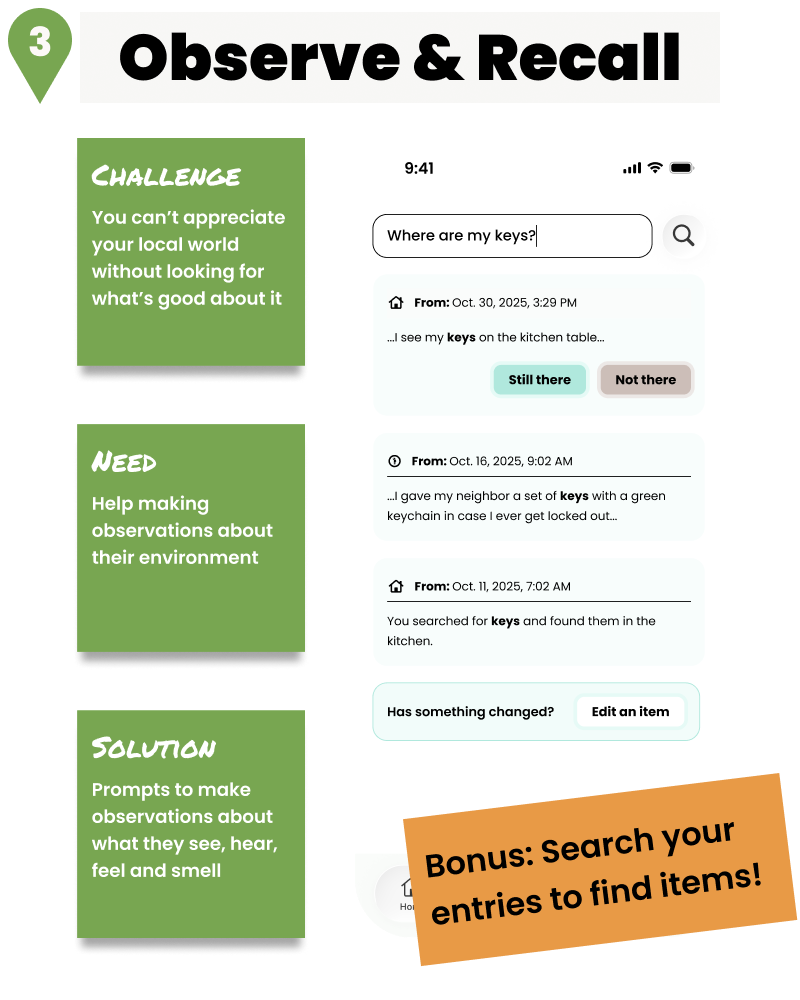
A user who wants to be more present locally also wants to pay attention to their surroundings.
Challenges:
- The user can’t focus on surroundings while they’re distracted by their phone
- You can’t appreciate your local environment if you don’t spend time looking for what’s good about it
- We all forget important details. This is especially difficult for people with medical conditions affecting their memory.
Needs:
- Help making meaningful observations about their environment
- Needs to find where they last observed something
Potential solutions:
- Entry feature for adding observations into the app
- Prompts to make observations about what they see, hear, feel and smell
- Reminders to stop and make a little observation
- Suggestions to take a walk so they can see something worth recalling
- Sorting and search mechanism so that items can be located where they were last observed
Additional Research Suggestions
For this project, I didn’t do all of the UX research necessary. I recommend additional steps to validate my initial assumptions and provide a stronger case for the how the app would solve meaningful user needs.
If I were to conduct additional research, I would focus on 3 aspects of the app’s user value.
- Desirability: Empathy interviews could determine if the app is solving real user problems. How much are people looking for an app like this to solve those real problems?
- Viability: There are already a lot of solutions out there for this idea. You can use existing features in popular apps to achieve the same effect. Some apps and websites such as NextDoor, a neighborhood-specific social media app, are solving these user needs.
- Feasibility: Most of the potential solutions I’ve identified seem feasible. But if any research uncovered new and better solutions, I would need to determine if they can be accomplished with existing solutions.
Prototype Implementation
The potential solutions I’ve identified could be implemented iteratively. The bare minimum features could be released as a complete app. After that, each upgrade would bring enhanced features that are much more complex to implement.
I’ve already built the easiest features.
- Ability to add observations as items
- Ability to tag items to appear in home, block, city and world tabs
- Sorting and search features
- A settings screen for adding your home address
I also toyed around with Google’s Programmable Search Engine feature to create a search engine that is limited to local results only. Here’s a link to my quick experiment with it.